What C.S. Lewis Can Teach Us About AI in Education
C.S. Lewis never wrote about artificial intelligence.
He never watched a student ask ChatGPT to write an essay. He never saw a teacher use an AI tool to generate lesson plans. He never had to decide whether a machine-produced paragraph counted as cheating, assistance, or something in between.
And yet, Lewis may be one of the most important voices for educators to recover in this moment.
Not because he predicted the machine.
Because he understood the classroom.
Lewis understood that education is never merely about transferring information from one mind to another. It is not only about producing correct answers, polished essays, or measurable outcomes. Education is about the formation of the person.
That is why the arrival of AI in schools requires more than a technical conversation. It requires a moral one.
The central question is not simply, “Can AI make education more efficient?”
It almost certainly can.
The better question is, “What kind of students will AI help us form?”
That is the question Lewis would want us to ask.
More Than a Tool
It is tempting to describe AI as just another educational tool. In one sense, that is true. A pencil is a tool. A calculator is a tool. A textbook is a tool. A search engine is a tool. AI, too, can be used by teachers and students for good purposes.
It can help a student brainstorm ideas. It can explain a difficult concept in simpler language. It can provide practice questions. It can help a teacher draft examples, rubrics, and parent communication. It can support students who need additional scaffolding.
Used wisely, AI can serve learning.
But Lewis would likely warn us against stopping there.
Tools are never neutral in the way we often imagine. They shape habits. They reward certain behaviors. They make some actions easier and others less likely. Over time, they train us to see the world in particular ways.
A classroom that uses AI only to save time may slowly teach students that time is the highest good.
A classroom that uses AI only to produce polished work may teach students that appearance matters more than understanding.
A classroom that allows AI to replace struggle may teach students that difficulty is something to avoid rather than something through which they grow.
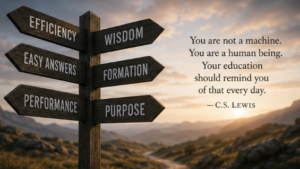
The machine may be new, but the danger is old.
Human beings have always been tempted to choose shortcuts over formation.
The Abolition of the Student
In The Abolition of Man, Lewis warned against an education that trains the intellect while neglecting the moral imagination. He feared the creation of people who were clever, capable, and technically skilled, but unformed in their loves, loyalties, and sense of truth.
That warning speaks directly to the age of AI.
Today, a student can generate an answer without understanding the question. A student can submit writing without having wrestled with the thought. A student can appear competent without developing the inner capacity that competence requires.
This is not only a problem of academic honesty.
It is a problem of human formation.
When students outsource too much of the learning process, they may lose more than a grade. They may lose the habits that education is meant to cultivate: attention, patience, humility, discipline, curiosity, courage, and responsibility.
Writing is not merely a product. It is a practice.
Reading is not merely information gathering. It is attention training.
Discussion is not merely participation. It is the formation of listening, reasoning, and respect.
Revision is not merely editing. It is the discipline of seeing one’s own thinking more clearly.
If AI bypasses these practices, then it does not simply change schoolwork. It changes the student.
Lewis would not ask only whether the assignment was completed.
He would ask what happened to the soul of the learner along the way.
The Temptation of Effortless Performance
Lewis understood temptation. In The Screwtape Letters, he portrayed evil not always as dramatic rebellion, but often as subtle misdirection. A person need not be made wicked all at once. Sometimes it is enough to make him distracted, vain, lazy, or comfortably self-deceived.
That is one of the great risks of AI in education.
The most obvious concern is cheating. But the deeper concern is the temptation of effortless performance.
AI can make it easier for students to appear thoughtful without thinking deeply. It can make it easier to appear articulate without developing voice. It can make it easier to appear prepared without practicing responsibility.
And because the product may look impressive, everyone may be tempted to accept the illusion.
The student gets the grade.
The teacher gets the assignment submitted.
The school gets the data point.
The machine gets the praise.
But has learning occurred?
Has the student become more capable, more truthful, more attentive, more responsible?
Or has the student simply learned how to hide behind fluent language?
Lewis would recognize the danger of confusing polish with wisdom.
The Imagination AI Cannot Replace
Lewis also understood imagination. Narnia was not merely entertainment. It was a world that invited readers to see reality differently. Through talking beasts, enchanted woods, false queens, brave children, and the great lion Aslan, Lewis awakened moral vision.
He knew that imagination is not an escape from truth. It is often a pathway into truth.
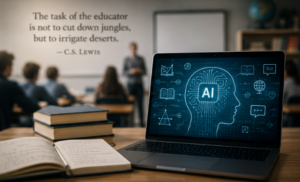
This matters because AI can now generate stories, images, poems, songs, and scenes in seconds. It can imitate styles. It can produce fantasy worlds. It can create the appearance of imagination.
But imagination is not merely output.
A child imagining Narnia is doing something different from a machine generating a fantasy scene. The child is longing, wondering, fearing, hoping, connecting, and discovering. The imagination is forming the person from the inside.
AI can assist creativity. It can offer prompts, examples, and possibilities. It can help students move past a blank page. But it cannot replace the student’s own encounter with wonder.
A machine can generate a lion.
It cannot teach a child to long for Aslan.
That distinction matters.
If AI becomes the place where students outsource imagination, then schools may produce more creative-looking work while forming less creative people.
A Lewisian classroom would use AI carefully here. It would not reject every generative tool, but it would protect the sacred space where students must imagine, attempt, revise, and create for themselves.
Teachers Are Not Machines
The AI conversation often focuses on students, but teachers are also being formed by these tools.
AI can help teachers. It can reduce repetitive tasks. It can generate first drafts. It can provide alternative explanations. It can help with planning and organization. For exhausted educators, this support may be genuinely valuable.
But Lewis would remind us that teaching is not merely content delivery.
Teachers are not machines that distribute information. They are human beings entrusted with the formation of other human beings.
A teacher notices confusion that a dashboard may miss. A teacher hears discouragement in a student’s voice. A teacher knows when to push, when to pause, when to encourage, and when to challenge. A teacher models love of subject, seriousness of purpose, and moral responsibility.
AI may assist the teacher.
It must not replace the teacher’s presence.
The danger is not only that students will become dependent on machines. The danger is that schools may begin to treat teachers as if they are machines too interchangeable, optimized, measured, and automated.
Lewis would resist any vision of education that reduces human beings to functions.
The teacher is not simply a content manager.
The student is not simply a data point.
The classroom is not simply a production system.
Education is a deeply human act.
A Better Standard for AI in Schools
So what would Lewis tell us to do?
He would likely avoid two extremes.
He would not say, “AI is evil, and therefore it must be banned everywhere.”
Lewis was too thoughtful for that. He understood that human beings can use tools wisely. He also understood that imagination, communication, and learning can happen through many forms.
But he also would not say, “AI is inevitable, and therefore schools must accept it without question.”
Lewis would be deeply suspicious of inevitability as a moral argument. The fact that something is powerful does not mean it is good. The fact that something is popular does not mean it is wise. The fact that something is efficient does not mean it is humane.
A Lewisian approach to AI in education would begin with purpose.
What is education for?
If education is merely the production of assignments, then AI will be judged by how quickly it helps produce them.
If education is merely the acquisition of credentials, then AI will be judged by how well it helps students obtain them.
If education is merely workforce preparation, then AI will be judged by whether it increases productivity.
But if education is the formation of human beings who can seek truth, love goodness, recognize beauty, practice responsibility, and serve others wisely, then AI must be judged by a higher standard.
Does this use of AI deepen understanding?
Does it preserve student responsibility?
Does it strengthen attention?
Does it cultivate honesty?
Does it support imagination?
Does it protect human relationships?
Does it help students become more capable, or does it simply make them more dependent?
Does it serve the teacher’s vocation, or does it reduce teaching to automation?
These are the questions schools need now.
The Lion and the Machine
The image may seem strange: the lion and the machine.
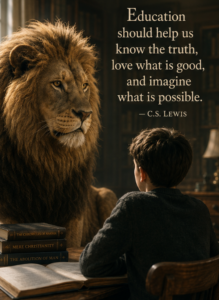
The lion represents something wild, noble, living, and morally serious. In Lewis’s imagination, Aslan is not safe, but he is good. He cannot be controlled, reduced, or domesticated.
The machine represents power, speed, calculation, and production. It can be useful. It can be impressive. It can serve human purposes. But it cannot become the source of meaning.
The classroom stands between them.
Every school must decide which vision will govern its use of AI.
Will the machine serve the formation of students?
Or will students slowly be formed to serve the logic of the machine?
That is the choice before us.
AI will almost certainly remain part of education. The question is whether it will be used with wisdom, restraint, imagination, and moral clarity.
Lewis would not ask first whether AI makes school faster.
He would ask whether it helps students become more fully human.
And that is the question every classroom must now face.