Artificial intelligence has created one of the most significant shifts in human learning and work since the arrival of the internet.
Yet much of the conversation remains focused on the wrong question.
Can AI write?
Can AI analyze?
Can AI create?
The answer to all three questions is increasingly yes.
Generative AI systems can now produce reports, presentations, summaries, lesson plans, code, graphics, and research support in seconds. With each new model release, these capabilities become more sophisticated.
But as artificial intelligence becomes more capable, a more important question emerges:
What role should humans play when AI can perform many of the tasks we once considered uniquely ours?
The answer may determine the future of education, workforce development, and leadership.
Rather than replacing human thinking, artificial intelligence is forcing us to redefine it.
The End of Information Scarcity
For most of modern history, information was scarce.
Schools were built around helping students acquire information. Businesses were built around gathering information. Expertise often depended upon who possessed the most knowledge.
Artificial intelligence has disrupted that model.
Information is no longer scarce.
Answers are available instantly.
Explanations can be generated on demand.
Research support can be produced in seconds.
The challenge facing both learners and professionals is no longer obtaining information. The challenge is determining what to do with it.
This shift changes the value of human contribution.
The future belongs less to information holders and more to information evaluators, managers, and interpreters.
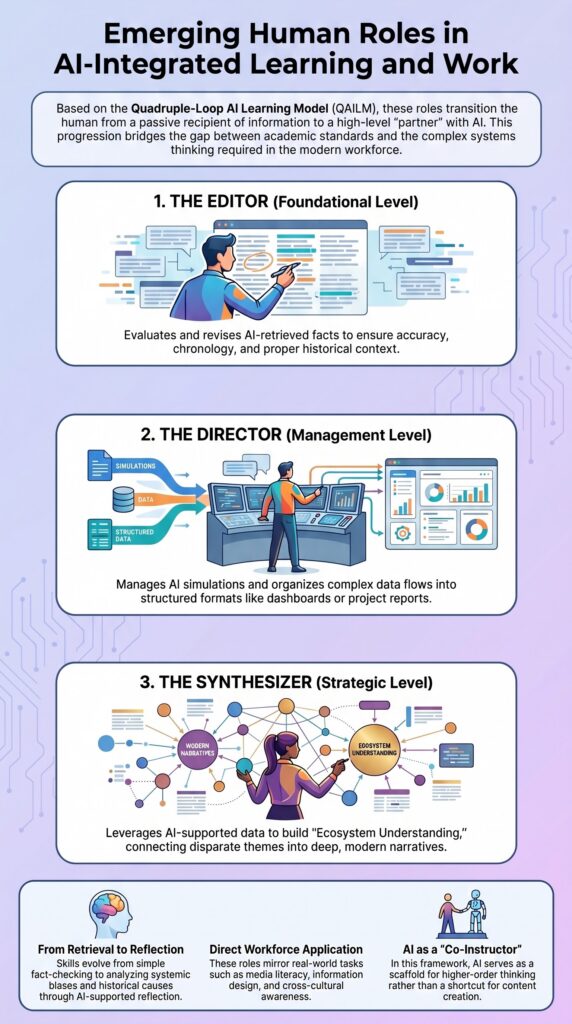
Through my work with the LAIR Framework and the Quadruple-Loop AI Learning Model (QAILM), three emerging human profiles have become increasingly visible.
These profiles are appearing not only in classrooms but also in workplaces, organizations, and leadership environments.
The Human as Editor
The first emerging profile is the Editor.
Editors evaluate.
They verify.
They question.
They improve.
While AI can generate content at remarkable speed, it cannot guarantee accuracy, context, fairness, or appropriateness.
Editors ask critical questions:
- Is this correct?
- What evidence supports this claim?
- What perspectives are missing?
- Does this output contain bias?
- How can this response be improved?
The Editor understands that AI output is a starting point rather than a final product.
As artificial intelligence becomes more powerful, the ability to identify weaknesses and improve outputs becomes increasingly valuable.
The future may belong not to those who generate the most content but to those who can distinguish quality from noise.
The Human as Director
The second emerging profile is the Director.
Directors manage systems.
They organize workflows.
They coordinate resources.
They determine how AI fits into larger objectives.
Rather than asking a single question, Directors guide a process.
They understand how to combine human expertise, technological tools, organizational goals, and available information to achieve meaningful outcomes.
In education, students may use AI to organize research, create visualizations, and structure presentations.
In business, employees may use AI to coordinate projects, analyze data, and streamline communication.
In both cases, the human remains responsible for direction.
AI executes.
Humans decide.
The Director profile reflects an important reality of the modern workforce.
Increasingly, success will depend not on performing every task personally but on managing increasingly complex systems of people, information, and technology.
The Human as Synthesizer
The third profile may be the most important.
The Synthesizer.
Synthesis is one of the highest forms of human thinking.
It involves connecting ideas that appear unrelated.
Recognizing patterns.
Identifying meaning.
Constructing understanding from multiple sources of information.
Artificial intelligence can retrieve facts.
It can summarize information.
It can identify correlations.
But synthesis requires something deeper.
Context.
Judgment.
Perspective.
Wisdom.
Synthesizers ask questions such as:
- What larger pattern is emerging?
- How do these ideas connect?
- What lessons can be learned?
- What implications exist beyond the immediate problem?
- How should this information influence future decisions?
This is where human value becomes most visible.
The ability to create meaning from information remains one of humanity’s most powerful capabilities.
Why This Matters Beyond Education
Although these profiles emerged from educational research, they extend far beyond the classroom.
Organizations increasingly need employees who can evaluate AI-generated information.
Leaders must determine how AI fits into strategic decision-making.
Professionals must balance efficiency with ethics.
Managers must coordinate human and artificial intelligence within the same workflow.
In every case, success depends upon human judgment.
The future workforce will not be divided between people who use AI and people who do not.
Virtually everyone will use AI.
The real distinction will be between those who rely on AI and those who direct it.
Between those who accept AI outputs and those who evaluate them.
Between those who consume information and those who synthesize meaning.
The Future Remains Human
Many discussions about artificial intelligence focus on what machines can do.
The more important conversation may be about what humans should do.
As AI becomes more capable, uniquely human capacities become more valuable.
Critical thinking.
Judgment.
Ethics.
Creativity.
Interpretation.
Leadership.
These are not disappearing.
They are becoming more important.
The future does not belong to artificial intelligence alone.
It belongs to the people who learn how to work with it thoughtfully and responsibly.
The future Editor.
The future Director.
The future Synthesizer.
These are not simply emerging student profiles.
They may become the defining human roles of the AI age.
About This Framework
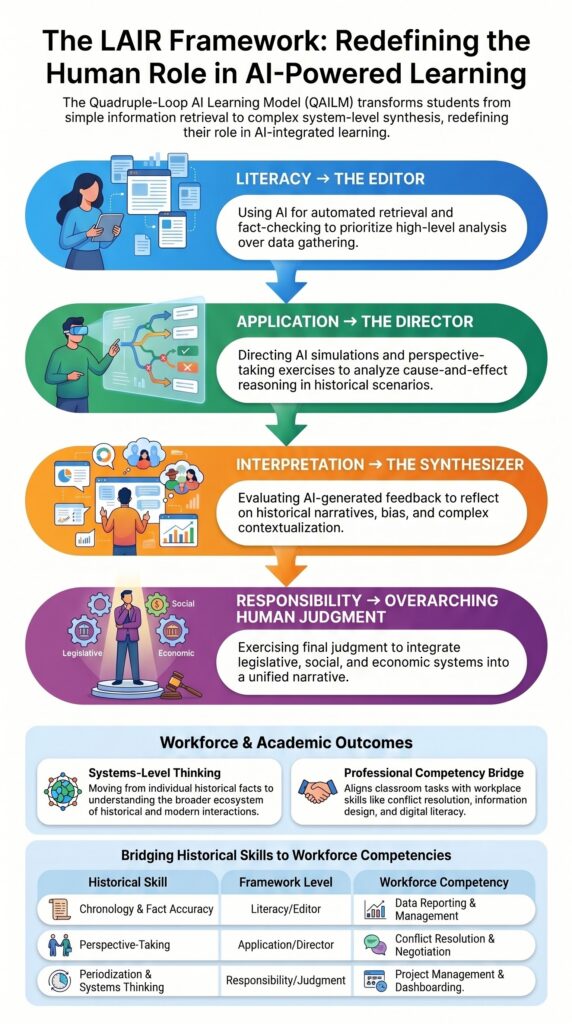
The Editor, Director, and Synthesizer profiles are derived from the LAIR Framework (Literacy, Application, Interpretation, and Responsibility) and the Quadruple-Loop AI Learning Model (QAILM), developed by Dr. Matt Meador through ongoing research into AI-integrated learning, human judgment, and instructional design. These concepts are explored in greater depth in the forthcoming book Building the LAIR: A Framework for Learning in the Age of Artificial Intelligence.