Author: Dr Matt Meador, Learning AI Institute
Artificial intelligence has changed the educational conversation.
For the past several years, discussions have focused on a single question:
Can students use AI to complete assignments?
The answer, of course, is yes.
Students can generate summaries, outlines, explanations, study guides, and even complete drafts in seconds. As generative AI tools become more sophisticated, the challenge facing educators is no longer determining whether students have access to information. Access is now abundant.
The more important question is this:
What role should students play when AI becomes part of the learning process?
The answer may require us to rethink what meaningful learning looks like in an AI-integrated world.
The Shift from Information Retrieval to Human Judgment
For generations, education has relied heavily on information acquisition.
Students located information.
Students organized information.
Students reproduced information.
Artificial intelligence now performs many of those tasks almost instantly.
As a result, the value of human learning is shifting away from simple retrieval and toward something far more important:
human judgment.
The future learner is not defined by how quickly they can find information but by how effectively they can evaluate, direct, and synthesize it.
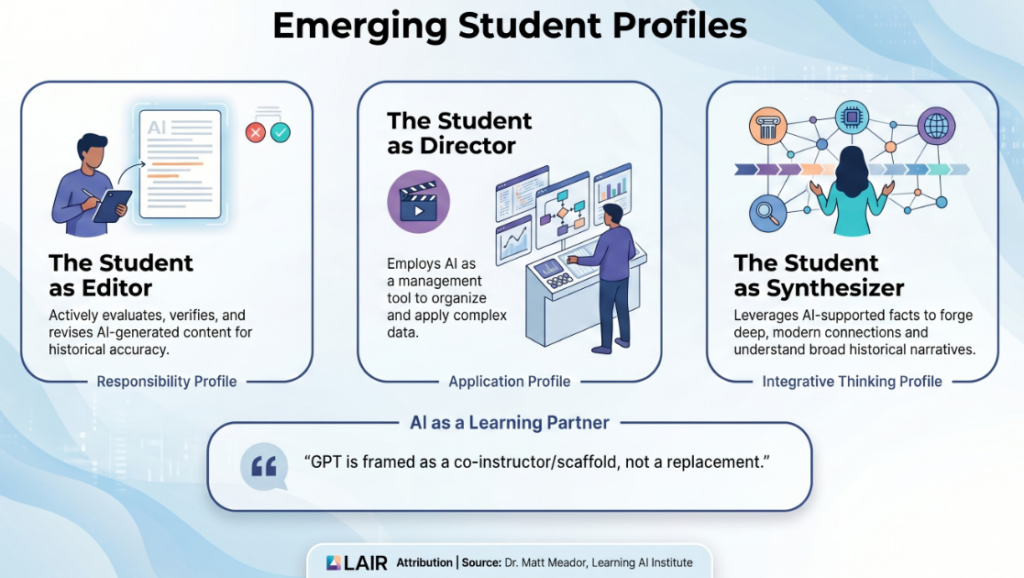
This shift is reflected in three emerging student profiles.
The Student as Editor
The first role emerging in AI-integrated learning is the student as editor.
In this role, the student is not a passive recipient of AI-generated content. Instead, the student actively evaluates, verifies, and revises AI output.
The editor asks questions such as:
- Is this information accurate?
- What evidence supports these claims?
- Are important perspectives missing?
- Does this response contain bias?
- How can this explanation be improved?
These questions require critical thinking rather than information retrieval.
As AI systems become more capable, the ability to identify errors, recognize limitations, and validate information becomes increasingly valuable.
In many ways, the editor role represents a modern form of digital literacy.
The student is responsible not for producing information alone but for ensuring its quality.
This is why the editor profile can be viewed as a responsibility profile.
The human learner remains accountable for the final product.
The Student as Director
The second emerging role is the student as director.
While the editor evaluates AI output, the director manages the interaction itself.
The director understands how to organize tasks, structure prompts, sequence activities, and use AI as a tool within a larger project.
Rather than asking AI a single question, the director coordinates an entire workflow.
For example, a student researching historical reform movements might:
- Use AI to summarize background information.
- Generate a comparison framework.
- Create visual representations of historical trends.
- Organize findings into a presentation.
- Refine explanations for different audiences.
The student remains in charge of the process.
AI becomes a support system rather than a replacement for thinking.
The director profile reflects an important reality of future work environments.
Increasingly, professionals will not simply complete tasks themselves. They will coordinate teams, technologies, data systems, and AI tools to accomplish larger objectives.
Learning environments that develop this capacity prepare students for those realities.
For this reason, the director can be understood as an application profile.
Students learn how to apply AI strategically rather than depend on it passively.
The Student as Synthesizer
The most advanced role may be the student as synthesizer.
Synthesis represents one of the highest levels of human cognition.
It involves connecting ideas, identifying patterns, integrating perspectives, and constructing new understanding.
While AI can generate information, synthesis requires meaning-making.
The synthesizer asks questions such as:
- How are these ideas connected?
- What larger pattern is emerging?
- What lessons from the past apply to the present?
- How do multiple perspectives reshape our understanding?
- What conclusions can be drawn from diverse sources?
This is where uniquely human thinking becomes most visible.
The synthesizer moves beyond facts and toward interpretation.
Beyond data and toward insight.
Beyond information and toward wisdom.
In history courses, synthesis might involve connecting labor reform, industrialization, immigration, and political change into a broader narrative about social transformation.
In science, it may involve connecting evidence across disciplines to explain complex systems.
In business, it could involve integrating market trends, customer behavior, and organizational strategy.
Regardless of discipline, synthesis represents the ability to transform information into understanding.
For this reason, the synthesizer can be viewed as an integrative thinking profile.
AI as a Learning Partner
One of the most significant misconceptions surrounding artificial intelligence is the belief that AI must either replace learning or be excluded from learning.
The reality is far more nuanced.
When used intentionally, AI can function as a learning partner.
Not a substitute for thinking.
Not a replacement for expertise.
Not a shortcut around understanding.
Instead, AI can serve as a scaffold that supports deeper engagement with content while preserving the human responsibility to evaluate, direct, and synthesize information.
This distinction is critical.
The goal is not to produce students who rely on AI.
The goal is to produce students who can work effectively alongside it.
Beyond the Classroom
Although these profiles emerge from educational contexts, they extend far beyond schools and universities.
The same transformation is occurring in workplaces across every industry.
Employees increasingly serve as:
- Editors who verify AI-generated reports and recommendations.
- Directors who manage AI-supported workflows and projects.
- Synthesizers who connect information across systems, departments, and strategic goals.
The future workforce will not be defined by who has access to artificial intelligence.
Everyone will.
The differentiator will be who can exercise sound judgment while using it.
The skills that matter most may be profoundly human:
- Critical evaluation
- Strategic decision-making
- Contextual understanding
- Ethical reasoning
- Systems thinking
These are the abilities that artificial intelligence can support but not fully replace.
The Future Belongs to the Synthesizer
The conversation about AI often focuses on technology.
The more important conversation may be about people.
As artificial intelligence becomes increasingly capable, the value of human learning may shift from producing information to interpreting it.
From completing tasks to directing them.
From consuming knowledge to creating meaning.
The emerging student is not simply a user of AI.
The emerging student is an editor.
A director.
A synthesizer.
And perhaps most importantly, a thinker.
That future depends not on what artificial intelligence can do, but on what humans choose to do with it.
About This Framework
The Editor, Director, and Synthesizer profiles are derived from the LAIR Framework and the Quadruple-Loop AI Learning Model (QAILM), developed by Dr. Matt Meador. These ideas are explored in greater depth in the forthcoming book Building the LAIR: A Framework for Learning in the Age of Artificial Intelligence.
For more information – visit metherbydesign.com