Artificial intelligence is no longer a future consideration in education it is a present reality. Students already interact with AI through search engines, recommendation systems, and generative tools. The strategic question for schools is no longer whether students will use AI, but whether they will be taught to use it well.
At MetHer By Design, we position AI literacy as a learning design and research problem rather than a technology adoption issue. Research consistently shows that the skills most predictive of long-term academic and professional success are critical thinking, inquiry, and evidence-based reasoning, not tool proficiency alone (OECD, 2021).
Our Learning AI for Research classes employ this approach, treating AI as a thinking partner that supports inquiry, verification, and judgment among middle and high school learners.
Middle School: From Curiosity to Evidence
Is Screen Time Hurting My Sleep?
Middle school students frequently hear claims about technology and health but rarely examine the evidence behind them. In this learning scenario, students use AI to investigate the relationship between screen time and sleep quality for adolescents.
Research indicates that excessive evening screen exposure, remarkably blue light, and cognitively stimulating content can adversely affect sleep duration and quality among children and adolescents (American Academy of Pediatrics, 2016; JAMA Pediatrics, 2019).
Students use AI to summarize findings, identify patterns, and translate research into appropriate age explanations.
Learning outcomes include:
- Framing focused research questions
- Distinguishing evidence from opinion
- Translating complex research into accessible language
Rather than replacing thinking, AI accelerates comprehension if students are taught how to interrogate what it provides.
Fact or Fake? Verifying Viral Claims
Adolescents increasingly consume news and information through social media platforms, where misinformation spreads rapidly. According to research by the Pew Research Center, many teens report difficulty distinguishing credible information from misleading or false claims encountered online (Pew Research Center, 2022).
In this scenario, students select a viral claim, use AI to evaluate its accuracy, and corroborate the findings with an independent, non-AI source.
This approach reinforces best practices in media literacy, which UNESCO identifies as a core competency for informed citizenship in the digital age (UNESCO, 2021).
Students learn to:
- Verify claims through triangulation
- Assess source credibility
- Understand confidence and uncertainty in research
The result is not skepticism for its own sake but disciplined inquiry.
High School: From Information to Judgment
Should Schools Use AI?
High school students are developmentally ready to engage complex, contested questions. In this scenario, students research both the potential benefits and risks of AI in education, drawing on perspectives from educators, policymakers, and researchers.
Global research suggests that AI can support personalization, feedback, and accessibility, while also raising concerns about data privacy, algorithmic bias, and overreliance when implementation lacks governance (World Economic Forum, 2023).
Students use AI to surface multiple viewpoints, then synthesize those perspectives into an evidence-based position.
This mirrors the analytical expectations students will encounter in post-secondary education, the workforce, and civic decision-making.
Does Social Media Affect Teen Mental Health?
The relationship between social media use and adolescent mental health is complex and frequently oversimplified. Large-scale studies show associations between heavy social media use and increased anxiety or depressive symptoms, but researchers caution against causal claims without nuance (U.S. Surgeon General, 2023).
In this activity, students use AI to examine where research aligns, where it diverges, and why findings may differ based on methodology or context.
Key learning outcomes include:
- Navigating ambiguity in research
- Understanding limitations of studies
- Engaging sensitive topics with analytical care
Students learn that strong reasoning often begins where certainty ends.
Why AI Literacy Must Be Research-Centered
AI literacy is often framed as tool familiarity. That frame is insufficient.
Educational research emphasizes that transferable learning depends on higher-order cognitive skills analysis, evaluation, and metacognition, not on surface-level procedural knowledge (National Research Council, 2012).
When AI is embedded within a research-centered learning design, students develop judgment rather than dependency. They learn not only how to generate information, but how to question it.
From “Using AI” to “Thinking With AI”: Why These Exercises Work
One of the biggest mistakes schools WILL MAKE with AI literacy is starting with tools instead of thinking. When AI is introduced without a clear instructional purpose, students either over-rely on it or disengage from it altogether.
The scenarios below, drawn from MetHer By Design’s AI Literacy Acceleration Program, illustrate an alternative approach. These exercises are not intended to teach students what AI can do. They are about teaching students how to think when AI is present.
Let’s break down why these designs work and why they scale.
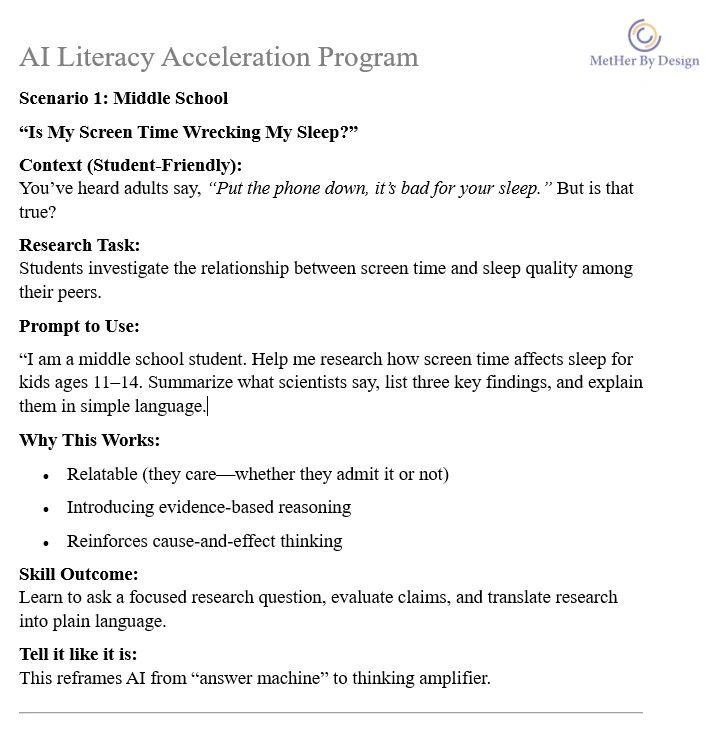
Scenario 1 (Middle School):
“Is My Screen Time Wrecking My Sleep?”
At the middle school level, relevance is non-negotiable. If students don’t see themselves in the question, cognitive effort drops fast.
This scenario succeeds because it begins with a claim that students already hear, rather than a topic imposed by adults. That move alone increases engagement and primes inquiry.
Instructional Strengths
1. Clear cognitive target
The task is not “research screen time.” The task is to evaluate a common claim using evidence. That distinction matters.
Students must:
- Identify: what scientists say
- Extract: key findings
- Translate: research into plain language
This aligns directly with early evidence-based reasoning and cause-and-effect thinking.
2. AI is framed as a thinking amplifier, not a shortcut
The prompt intentionally constrains the AI’s role. It does not ask for an answer; it asks for summarization, synthesis, and explanation. That keeps the student in the driver’s seat.
3. Developmentally appropriate rigor
Middle school students are not asked to critique methodology or debate causality. They are asked to understand patterns and communicate meaning exactly where they should be.
Why This Matters
This exercise quietly reframes AI from an “answer machine” into a comprehension accelerator. Students learn that AI is beneficial only if they ask focused questions and evaluate the responses.
That’s AI literacy at the right altitude.
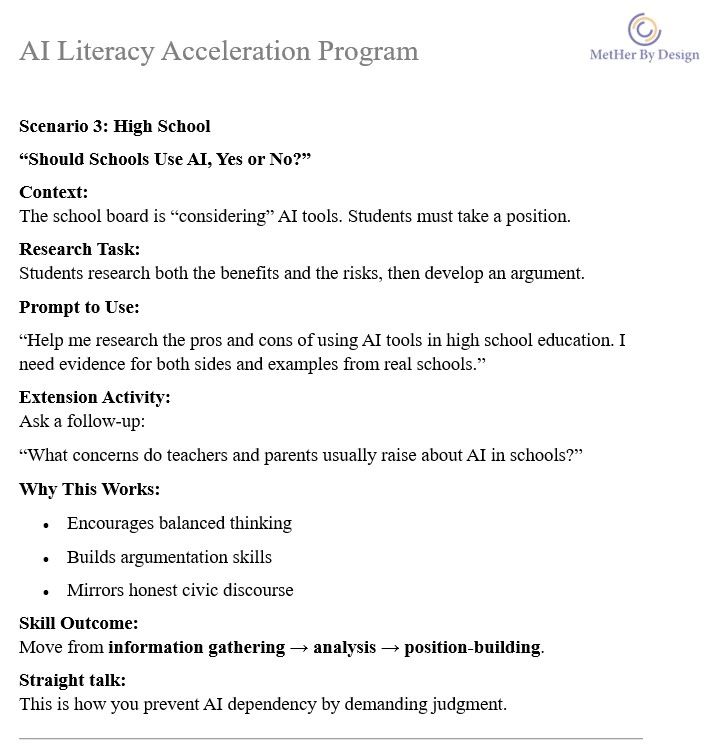
Scenario 3 (High School):
“Should Schools Use AI, Yes or No?”
This scenario transitions students from inquiry to judgment, where AI literacy either succeeds or fails.
Rather than telling students what to think about AI in schools, this exercise requires them to take a position after researching both sides.
Instructional Strengths
1. Balanced cognitive demand
Students must engage in:
- Information gathering
- Analysis of competing perspectives
- Position-building supported by evidence
This mirrors the kind of reasoning expected in college, the workplace, and civic life.
2. Productive tension by design
There is no “correct” answer. That’s intentional. The value is not in conclusion, but in the quality of reasoning used to achieve it.
The extension prompt that asks about teacher and parent concerns requires students to consider perspectives they may not naturally consider.
3. Explicit guardrail against AI dependency
By demanding a position, the exercise prevents students from hiding behind AI output. They must interpret, weigh, and decide.
AI can surface viewpoints, but it cannot choose for them.
Why This Matters
This scenario trains students to operate in complex, contested spaces exactly where AI will be most present in their future lives. It teaches discernment, not compliance.
What These Exercises Get Right About AI Literacy
Across both scenarios, several design principles stand out:
- AI is embedded within a research process, not bolted on as a novelty
- Prompts are constrained and intentional, reducing misuse
- Students are accountable for interpretation and judgment, not just output
- The focus is transferable thinking, not platform-specific skills
In short: these are not “AI activities.”
They are learning activities that happen to use AI.
That distinction lies between literacy and dependence.
The MetHer By Design Position
AI does not replace thinking; it exposes the quality of thinking already happening.
At MetHer By Design, our Learning AI for Research approach helps schools and communities move beyond fear, hype, or prohibition and toward intentional, ethical, and practical use of AI.
We design learning experiences that align pedagogy, research, and technology so that students are prepared not only to use AI but also to think well in a world shaped by it.
References
American Academy of Pediatrics. (2016). Media and young minds. Pediatrics, 138(5). https://doi.org/10.1542/peds.2016-2591
JAMA Pediatrics. (2019). Associations between screen time and sleep outcomes in adolescents.
National Research Council. (2012). Education for life and work: Developing transferable knowledge and skills in the 21st century. National Academies Press.
OECD. (2021). Global competency and critical thinking in education.
Pew Research Center. (2022). Teens, social media, and technology.
UNESCO. (2021). Media and information literacy: Policy and strategy guidelines.
U.S. Surgeon General. (2023). Social media and youth mental health: Advisory.
World Economic Forum. (2023). Shaping the future of learning: Artificial intelligence in education.