Most organizational leaders assume their HR platforms provide a clear view of workforce capability. In reality, many HR dashboards answer administrative questions, such as headcount, compliance, and completion, while edtech dashboards answer learning questions, such as practice, mastery, and growth. That distinction matters more than ever as we have shifted distinctly to a skills-based economy.
A close look at a modern EdTech dashboard reveals a level of behavioral and skill-level insight that most HR systems still struggle to provide: time spent practicing, questions attempted, mastery by discrete skill, and aggregate patterns without losing individual “signals”. These are not vanity metrics; they are learning telemetry.
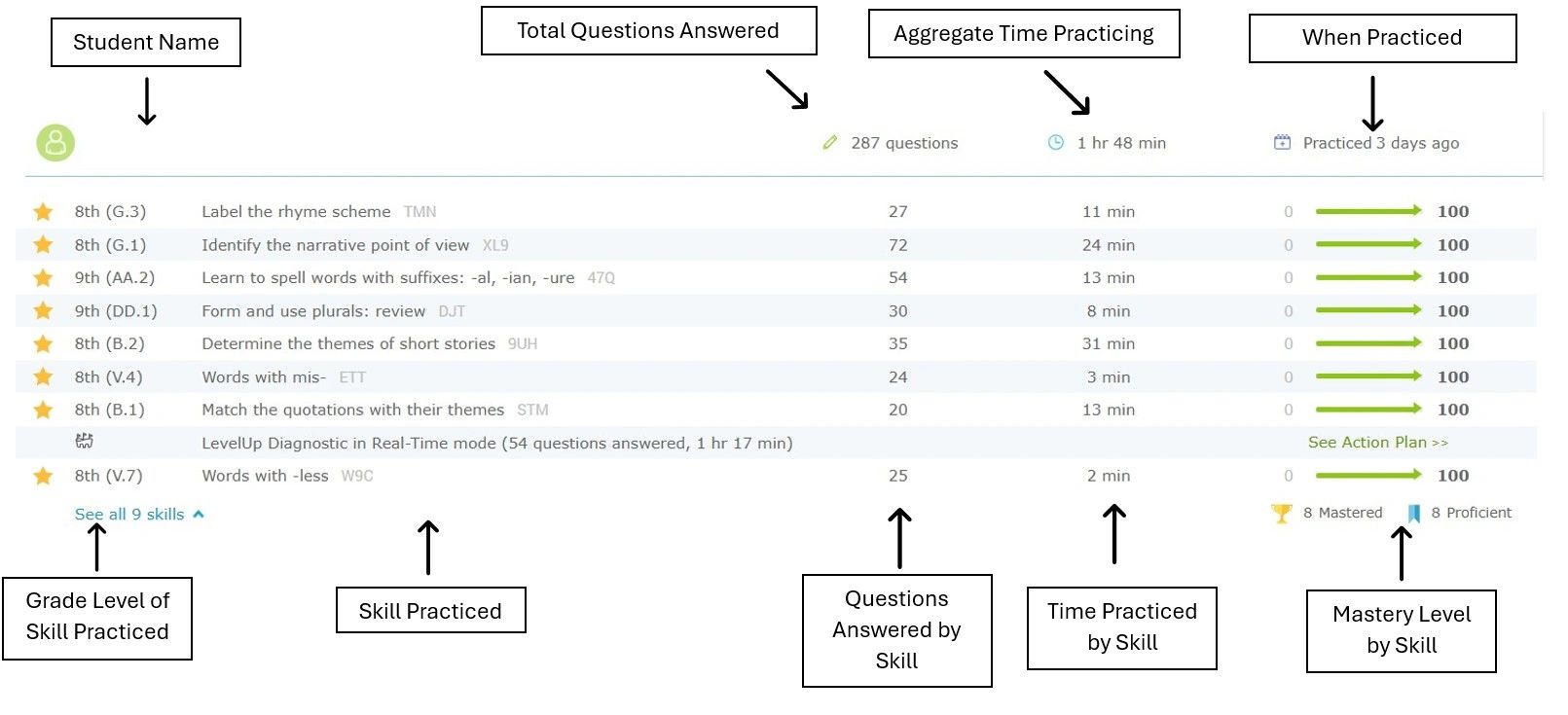
This article examines why edtech dashboards are structurally superior for skill tracking, where leading HR platforms fall short, and how organizations can design a workforce intelligence stack that actually supports learning and performance.
EdTech Dashboards Measure What HR Platforms Typically Do Not
At their core, EdTech dashboards are designed to answer one question: Is learning actually happening? To do this, they track learning as behavior rather than just completion.
Standard EdTech metrics include:
- Time practiced, not just time enrolled
- Output measures, such as questions answered or tasks attempted
- Skill-level mastery, broken down by topic or difficulty
- Progression over time, visible at both the individual and cohort levels
These metrics reflect principles from learning science, particularly deliberate practice and mastery learning, which emphasize repeated effort, feedback, and progression rather than one-time exposure (Ericsson, 2006; Bloom, 1984).
By contrast, many HR platforms emphasize:
- Course completion
- Credit hours
- Certifications earned
- Manager or self-reported proficiency ratings
Indicators are useful for compliance and reporting, but they offer little insight into whether employees can actually perform. Nothing currently available provides an out-of-the-box experience that aligns with the EdTech image. Although things can be pieced together, some of these connections can be complex.
Why Most HR Platforms Fall Short on Skill Mastery
The gap we face is not accidental. HR platforms were historically built as systems of record, NOT systems of learning intelligence. Their primary design constraints are payroll accuracy, job architecture, and regulatory compliance, not cognitive development.
Even modern platforms such as Workday, SAP SuccessFactors, and Cornerstone OnDemand include learning modules that still rely heavily on:
- Binary completion logic
- Self-assessed or manager-assessed skills
- Coarse-grained reporting intervals
As a result, organizations often believe they are “skills-based” when, in practice, they are still credential-based.
Learning experience platforms (LXPs) such as Degreed move closer to a skills ontology by mapping content to skills and tracking engagement. However, even these platforms frequently infer mastery indirectly rather than measuring practice and performance explicitly.
The Strategic Risk of Confusing Learning with Completion
When organizations equate learning with course completion, three predictable risks emerge:
- False confidence
Leaders assume capability exists because training was completed, not because performance improved. - Poor investment decisions
Resources continue to flow into platforms and content libraries that show activity but no impact. - Stagnant learning cultures
Employees learn that checking boxes matters more than developing competence.
Research on learning organizations consistently shows that sustainable performance improvement depends on feedback loops, reflection, and continuous skill refinement—not episodic training events (Meador, 2021; Senge, 2006; Garvin, Edmondson, & Gino, 2008).
The Smarter Model: A Workforce Learning Intelligence Stack
Organizations that want EdTech-level insight into workforce skills should stop searching for a single “perfect” HR platform. It does not exist. Instead, high-performing organizations adopt a layered architecture:
- HRIS is the system of record (jobs, roles, pay)
- LXP or LMS for skill-aligned learning experiences
- Analytics layer for practice, mastery, and progression
- AI-supported insights to surface patterns and gaps
In this model, HR systems answer who is employed, while learning systems answer who is improving.
This shift aligns with the broader move toward skills-based organizations, where workforce value is defined less by titles and more by demonstrated capability (World Economic Forum, 2023).
Why This Matters Now
Artificial intelligence is accelerating skill obsolescence while simultaneously enabling more precise measurement of learning behaviors. Organizations that continue relying solely on completion-based HR dashboards will fall behind those that treat learning as a measurable, improvable system.
The future belongs to organizations that can answer questions like:
- Which skills are employees actively practicing?
- Where is mastery progressing or stalling?
- How does learning behavior correlate with performance outcomes?
EdTech dashboards already answer these questions. HR platforms must either evolve or integrate to remain strategically relevant.
Conclusion
EdTech dashboards outperform traditional HR platforms not because they are more advanced technologically, but because they are grounded in how people actually learn. Organizations that want real workforce capability, not just compliance metrics, must rethink how they track learning, skills, and mastery.
The takeaway is straightforward: learning intelligence is not an HR feature; it is an organizational capability. Designing for it requires intentional systems thinking, not another checkbox in the LMS.
References
Bloom, B. S. (1984). The 2 sigma problem: The search for methods of group instruction as effective as one-to-one tutoring. Educational Researcher, 13(6), 4–16.
Ericsson, K. A. (2006). The influence of experience and deliberate practice on the development of superior expert performance. Cambridge University Press.
Garvin, D. A., Edmondson, A. C., & Gino, F. (2008). Is yours a learning organization? Harvard Business Review, 86(3), 109–116.
Meador, M. (2021). Learning organizations in a time of crisis (Doctoral dissertation, University of Memphis).
Senge, P. M. (2006). The fifth discipline: The art and practice of the learning organization. Doubleday.
World Economic Forum. (2023). The future of jobs report. World Economic Forum.