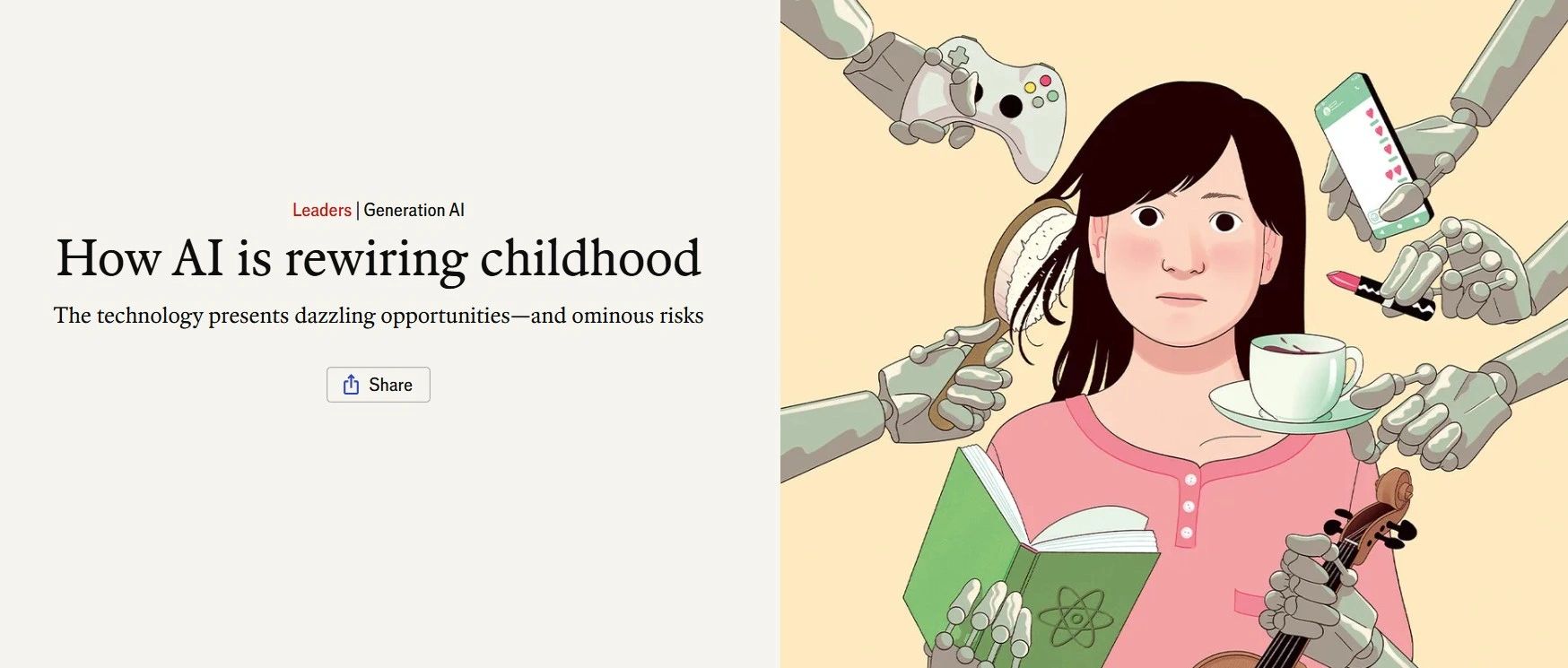
Read The Economist lately? I just so happened to come across an article today, the 4th of December 2025. I suppose when The Economist published its leader on artificial intelligence and childhood, it didn’t mince words: AI is rewiring childhood (The Economist, 2025a). Not “supporting,” not “enhancing,” but rewiring, suggesting a foundational shift in how children grow, learn, socialize, and interpret the world.
That framing should stop every educator, policymaker, and parent in their tracks. We are no longer debating whether AI will impact childhood. It already has. The real question is whether we will guide that transformation or chase it after the fact.
In my work with learners and school districts, I see this tension every day. AI opens remarkable doors, yet the risk surface widens just as quickly. The opportunity is undeniable; the responsibility is enormous.
Let’s break down what The Economist and other global voices are signaling and what it means for the next decade of childhood.
AI’s Promise: A Personal Tutor for Every Child
One of the most significant insights from The Economist is that early evidence shows AI is already improving children’s literacy acquisition and language learning (The Economist, 2025a). Personalized tutoring, once available only to those with financial means, is becoming democratized through AI.
This is not incremental improvement; this is structural transformation.
AI can:
- Adapt to a child’s learning speed
- Offer unlimited practice without frustration
- Provide multi-language support
- Detect misconceptions early
- Reinforce foundational skills through natural conversation
For multilingual learners, students with disabilities, and schools with limited instructional personnel, this could be a breakthrough. Research from Ahearn et al. (2025) demonstrates that AI is accelerating progress for students who historically struggle within traditional models.
Meanwhile, The Economist’s companion briefing highlights how both schools and homes are already offloading parts of instruction, practice, and even emotional scaffolding to AI systems (The Economist, 2025b). Whether we like it or not, the shift is underway.
But Let’s Be Honest: The Risks Are Real
Every innovation has a shadow side. AI in childhood is no exception.
The Economist points to “ominous risks” baked into this technological wave (2025a). Chief among them: we don’t fully understand how AI will affect cognitive development, attention, and social interaction in the long term.
UNICEF (2024) raises similar alarms. Early childhood is a sensitive period for neural and social development. What happens when young children outsource curiosity, exploration, or emotional regulation to an algorithm? What happens when an AI “friend” is more patient, more engaging, or more affirming than peers?
The Guardian offers another perspective, noting that AI-powered toys and companions blur the lines between machine and relationship, collecting staggering amounts of data while shaping children’s emotional habits (Hern, 2025).
Equity is another concern. AI has the potential to close gaps, but only if the tools are accessible. Otherwise, we widen a new digital divide: those raised with high-quality AI support and those raised without it.
And let’s not overlook the long game: the risk of intellectual dependency. More than a decade ago, Nicholas Carr (2008) worried whether technology was making adults intellectually passive. What happens when children grow up never knowing a world without an algorithmic co-thinker?
We Are Not Preparing Children for an AI World. We’re Preparing Parents and Schools for One…
A leading economist at OpenAI recently argues that the most essential AI-era skills for children will not be technical but human: adaptability, critical thinking, resilience, and continuous learning (Stokel-Walker, 2025).
The message is crystal clear, going beyond today.
Childhood is no longer just about absorbing content; it’s about developing capabilities that thrive alongside AI, not beneath it.
Schools are scrambling. Parents are unsure how to set boundaries. Policymakers are far behind. The Economist is right: childhood is being rewired. The question is whether we will design the circuitry ourselves or let commercial systems handle it.
A Responsible Path Forward
Here are the non-negotiables if we want AI to enhance childhood rather than erode it.
Prioritize Human Skills Over Tech Skills
Critical thinking, communication, creativity, and empathy must remain central. AI can assist learning, but it cannot replace human struggle, collaboration, or discovery.
Establish Guardrails Early and Transparently

Schools and families need clear age-appropriate guidelines:
- When is AI appropriate?
- For how long?
- For which tasks?
- With what data protections?
Without guardrails, usage patterns will be shaped by convenience rather than child development.
Ensure Opportunity for Access
If we fail here, AI becomes another form of socioeconomic sorting. Every child deserves access to high-quality AI learning support, no exceptions.
Support Research and Continuous Evaluation
We need longitudinal studies. We need monitoring. We need to understand how AI alters socialization, cognition, and identity.
The rewiring is happening; the oversight is not keeping pace.
AI Literacy is “THE” Core Competency
Not how to “use the tools,” but how to:
- Question AI responses
- Recognize algorithmic bias
- Understand training implications
- Use AI for learning rather than outsourcing thinking
Children need to see AI as a partner, not a parent.
Final Word: Childhood Is Changing, Leadership Must Step Up
The Economist is not sounding an alarm to be provocative; it’s documenting a shift that educators are witnessing on the ground every day. AI can make childhood richer, more supported, and more equitable, but only with intentional leadership guiding the integration.
If we get this right, we give the next generation a childhood amplified by intelligence. If we get it wrong, we let the technology shape them in ways we don’t yet understand.
Let’s make sure the new circuitry serves children, not the system.
References
Ahearn, L., Singh, A., & Martínez, C. (2025). AI-supported inclusive education: Emerging evidence and challenges (arXiv:2504.14120). arXiv. https://arxiv.org/abs/2504.14120
Carr, N. (2008). Is Google making us stupid? The Atlantic. https://www.theatlantic.com/magazine/archive/2008/07/is-google-making-us-stupid/306868/
Hern, A. (2025, September 18). How will childhood be changed by AI toys? The Guardian. https://www.theguardian.com/lifeandstyle/2025/sep/18/how-will-childhood-be-changed-by-ai-toys
Stokel-Walker, C. (2025, July). OpenAI economist says kids will need four key skills to thrive in an AI-powered future. Business Insider. https://www.businessinsider.com/openai-economist-teaching-kids-4-skills-to-prepare-for-ai-2025-7
The Economist. (2025a, December 4). How AI is rewiring childhood. https://www.economist.com/leaders/2025/12/04/how-ai-is-rewiring-childhood
The Economist. (2025b, December 4). At home and at school, AI is transforming childhood. https://www.economist.com/briefing/2025/12/04/at-home-and-at-school-ai-is-transforming-childhood
UNICEF. (2024, October). AI and early childhood development: Opportunities and risks. https://www.unicef.org/media/163786/file/2024-10_Blog%20ECD%20and%20AI_cw_zj_am.pdf.pdf