C.S. Lewis never had to decide whether a student should use ChatGPT to draft an essay. He never had to wonder whether teachers should use artificial intelligence to grade assignments, generate lesson plans, or provide instant feedback. He died decades before artificial intelligence entered ordinary classrooms.
And yet, Lewis may be one of the more useful voices for thinking about AI in education.
Not because he predicted it. He did not.
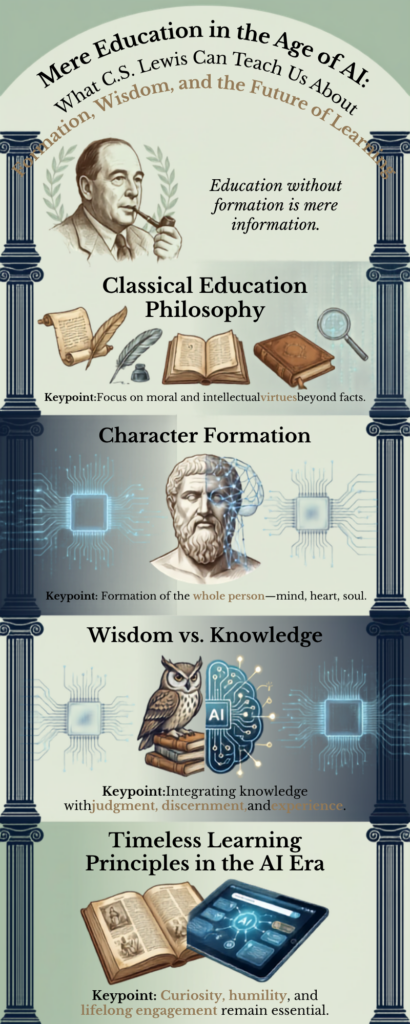
Lewis is useful because he understood something modern education often forgets: education is never merely about information. It is about formation.
That distinction matters.
When schools discuss artificial intelligence, the conversation often begins with efficiency. Can AI help teachers save time? Can it help students write faster? Can it personalize instruction? Can it generate lesson plans, quizzes, summaries, study guides, and feedback?
These are practical questions, and they are not unimportant. Teachers are overextended. Students need support. Schools are under pressure. Any tool that responsibly reduces unnecessary burden deserves serious consideration.
But Lewis would likely press us toward a deeper question:
What kind of person is this tool helping form?
That is the question beneath the AI debate.
If AI helps a student clarify an idea, test an argument, receive feedback, or practice a skill, it may serve education well. If it helps a teacher spend less time on mechanical tasks and more time mentoring students, it may serve education well. If it gives struggling learners access to explanations, examples, and encouragement they would not otherwise receive, it may serve education well.
But if AI allows students to avoid the hard work of thinking, writing, reading, revising, remembering, and wrestling with truth, then it does not merely change the assignment.
It changes the student.
Lewis would have recognized that danger.
In The Abolition of Man, Lewis warned against educational systems that produce people with technical ability but without rightly ordered loves, judgment, and moral imagination. His concern was not that students would know too much. His concern was that they might be trained to manipulate the world without being formed to love what is true, good, and beautiful.
That warning feels remarkably relevant in the age of AI.
A student can now produce polished language without understanding. A paragraph can sound intelligent while concealing intellectual emptiness. A summary can replace reading. A chatbot can simulate reflection. A machine can offer the appearance of learning without the inward struggle that learning requires.
This does not mean AI should be banned from education.
Lewis was not a simplistic anti-modernist. He used the tools of his time. He wrote for radio. He engaged popular media. He understood that imagination could travel through many forms.
The issue is not whether a tool is new.
The issue is whether the tool serves the human person or quietly diminishes him.
In education, this means schools must move beyond the question, “Did AI produce this?” and toward better questions:
Did the student understand it?
Did the student wrestle with it?
Did the student become more capable because of the process?
Did the tool strengthen attention, judgment, humility, and responsibility?
Did it merely make avoidance easier?
Lewis would likely remind us that the goal of education is not to produce students who can generate acceptable answers. It is to form students who can seek truth, recognize beauty, practice virtue, and communicate honestly.
AI can assist that mission, but it cannot replace it.
The danger is not that machines will become too intelligent. The more immediate danger is that humans may become too willing to outsource the very practices that make intelligence meaningful.
Writing matters not only because it produces essays, but because it disciplines thought.
Reading matters not only because it transfers information, but because it trains attention.
Discussion matters not only because it produces answers, but because it forms patience, listening, and humility.
Struggle matters not because suffering is romantic, but because students are shaped by the effort required to move from confusion to understanding.
A Lewisian approach to AI in education would therefore avoid both panic and surrender.
It would not say, “AI is evil; keep it out.”
It would not say, “AI is inevitable; let it in without limits.”
It would say something harder and wiser:
Use the tool only where it serves the formation of the student.
That is the standard schools need.
Not novelty.
Not convenience.
Not fear.
Not efficiency alone.
Formation.
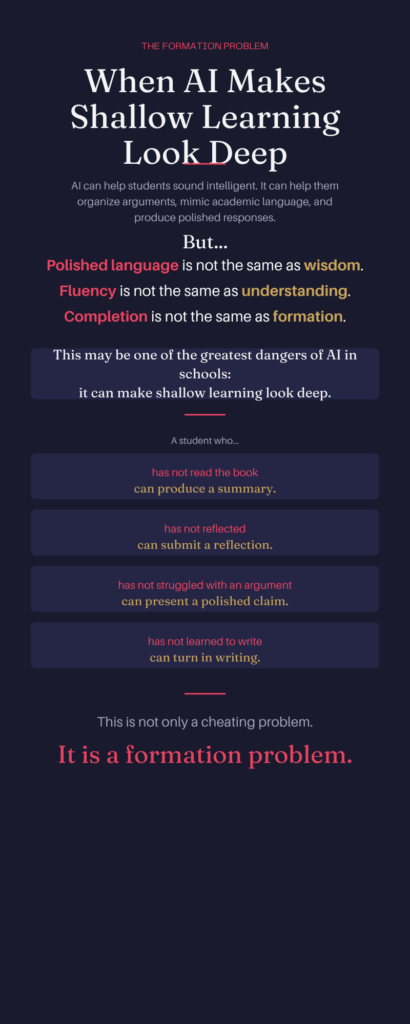
The AI question is ultimately a human question. What are we teaching students to love? What are we training them to notice? What habits are we strengthening? What responsibilities are we allowing them to avoid? What kind of people are they becoming?
Lewis would want us to ask those questions before the machine answers for us.