By Dr. Matt Meador
Executive Director, Learning AI Institute
When conversations around AI in education and organizational learning happen today, most discussions remain focused on tools, automation, or efficiency, but the deeper challenge is not simply using AI. The challenge is learning how to think, adapt, interpret, and respond inside systems that are changing faster than traditional structures can absorb. That is where the connection between the LAIR Framework and Quadruple-Loop Learning Theory becomes significant.
The Problem with Surface-Level Learning
Many organizations still operate inside what researchers describe as single-loop learning:
- Something fails
- A correction is made
- The system moves on
The problem is that this approach rarely questions:
- underlying assumptions,
- environmental context,
- changing realities,
- or whether the original system itself still makes sense.
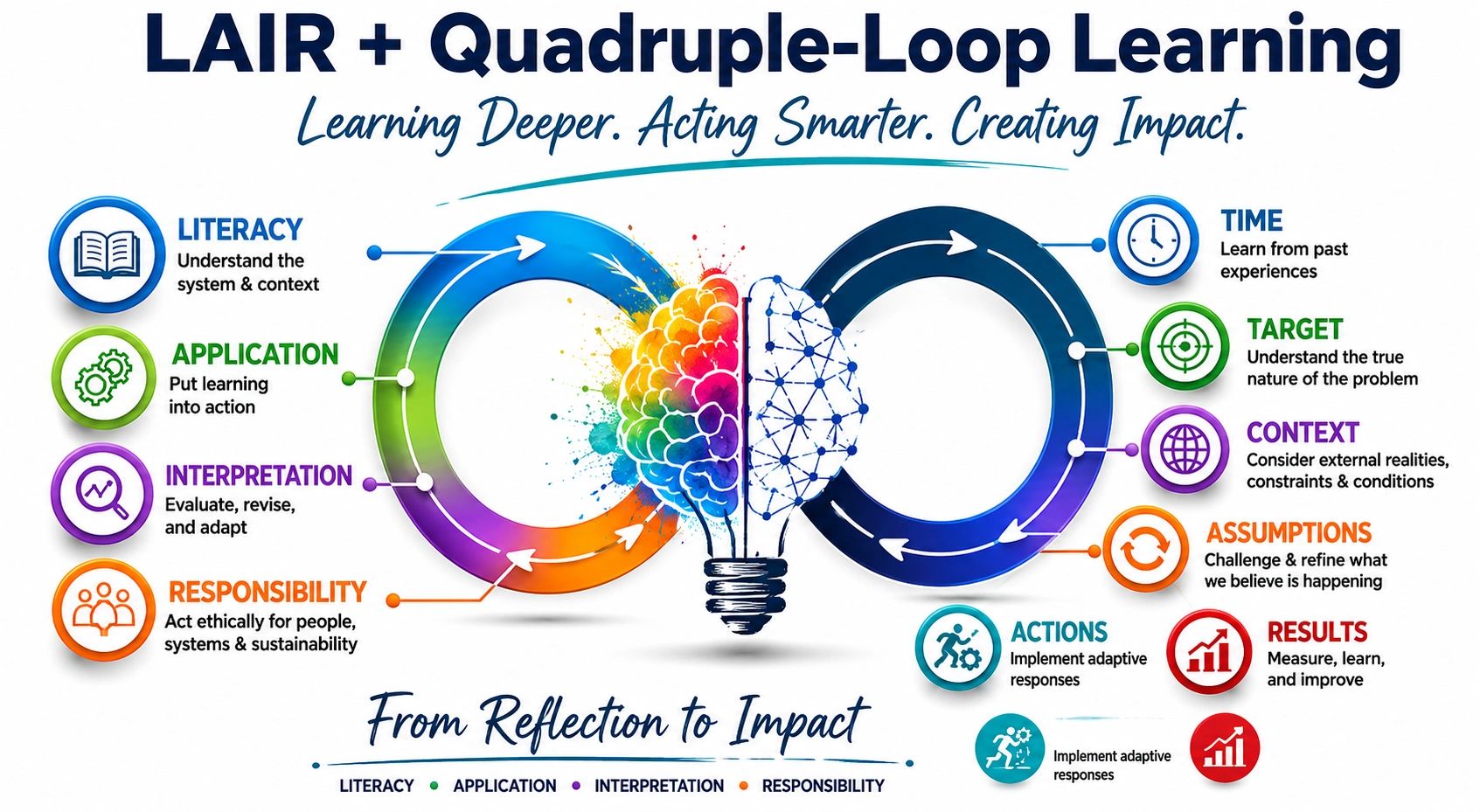
In the article “Policy Learning and Crisis Policy-Making: Quadruple-Loop Learning and COVID-19 Responses in South Korea,” researchers Lee, Hwang, and Moon examined why South Korea adapted more effectively to COVID-19 than many other nations. Their conclusion was not simply that Korea acted quickly. It was that Korea learned deeply. The authors proposed a framework called Quadruple-Loop Learning, which expands traditional organizational learning into a continuous process involving:
- Time (learning from past experiences)
- Target (understanding the actual nature of the problem)
- Context (considering external realities)
- Continuous adaptation between assumptions, actions, and outcomes
As I examined the framework, the alignment with the LAIR Framework became increasingly clear.
Where LAIR Aligns
The LAIR Framework — Literacy, Application, Interpretation, and Responsibility — operationalizes the very process that quadruple-loop learning describes.
Rather than viewing learning as linear, LAIR structures learning as adaptive, reflective, and continuously evolving.
Literacy: Understanding the System Before Acting
Quadruple-loop learning begins with understanding:
- prior failures,
- the nature of the challenge,
- and environmental realities.
In the South Korean COVID-19 response, leaders drew directly from previous SARS and MERS failures to reshape future responses. This is precisely what Literacy represents inside LAIR. Literacy is not merely information acquisition.
It is the ability to:
- identify systems,
- recognize patterns,
- understand context,
- and define the actual problem before intervention occurs.
Without Literacy, organizations confuse reaction with understanding.
Application: Turning Learning into Action
The Korean government did not stop analyzing.
It implemented:
- testing systems,
- tracing systems,
- communication systems,
- and adaptive public health responses.
That is Application.
In LAIR, Application means transforming understanding into structured action. AI literacy without application produces passive knowledge. Application transforms learning into capability.
Interpretation: Revising Assumptions in Real Time
One of the most powerful elements of quadruple-loop learning is its emphasis on changing assumptions as new information emerges. The framework specifically notes that organizations must continuously reassess:
- assumptions,
- actions,
- and outcomes as situations evolve.
This directly aligns with Interpretation inside LAIR.
Interpretation is the ability to:
- evaluate outputs,
- reassess conclusions,
- refine understanding,
- and adapt decisions based on evidence rather than ideology.
This becomes critically important in AI-supported environments where:
- information changes rapidly,
- outputs may be incomplete,
- and certainty becomes dangerous.
Interpretation is what prevents automation from becoming intellectual dependency.
Responsibility: Human-Centered Decision Making
Perhaps the strongest alignment appears in Responsibility.
The South Korean response balanced:
- public health,
- economic stability,
- democratic governance,
- transparency,
- and citizen participation.
This is not merely operational success, but ethical systems thinking.
Responsibility within LAIR asks:
- What are the consequences of this action?
- Who is affected?
- How do systems remain sustainable?
- How do we maintain human agency while leveraging advanced technology?
In AI education, Responsibility becomes the layer that separates:
- amplification from manipulation,
- empowerment from dependency,
- and learning from automation theater.
LAIR as Operationalized Quadruple-Loop Learning
The most important realization is this:
Quadruple-loop learning explains the depth of adaptive learning.
LAIR operationalizes it.
LAIR translates abstract organizational learning theory into a usable framework for:
- schools,
- institutions,
- AI literacy initiatives,
- leadership systems,
- and human-centered technology integration.
The alignment looks like this:
Quadruple-Loop Learning
LAIR Framework is…
Literacy = Learning from experience
Literacy + Interpretation = Understanding the true problem
Application = Responding through adaptive systems
Interpretation = Revising assumptions continuously
Responsibility = Balancing ethics, systems, and society
Why This Matters Now
We are entering an era where:
- AI can generate answers instantly,
- but systems still fail to think deeply.
The danger is not simply misinformation, but the presence of superficial learning disguised as intelligence. Organizations, schools, and governments that survive the AI transition will not simply be the fastest adopters of technology.
They will be the organizations capable of:
- reflective adaptation,
- contextual understanding,
- ethical decision-making,
- and continuous learning.
That is the true value of LAIR. Not as another AI framework, but as a structure for learning how to think inside rapidly evolving systems.
References
Lee, S., Hwang, C., & Moon, M. J. (2020). Policy learning and crisis policy-making: Quadruple-loop learning and COVID-19 responses in South Korea. Policy and Society, 39(3), 363–381. https://doi.org/10.1080/14494035.2020.1785195
Argyris, C. (1976). Single-loop and double-loop models in research on decision making.Administrative Science Quarterly, 21(3), 363–375.
Tosey, P., Visser, M., & Saunders, M. N. (2012). The origins and conceptualizations of triple-loop learning: A critical review. Management Learning, 43(3), 291–307.