How many of us are on LinkedIn? I am! That is my go-to platform for learning from practitioners in the field. Sure, we all network a bit, but there’s still plenty to learn. For example, I was impacted by this post from Zsolt Olah on 19 September 2025. I really think that he is on to something.
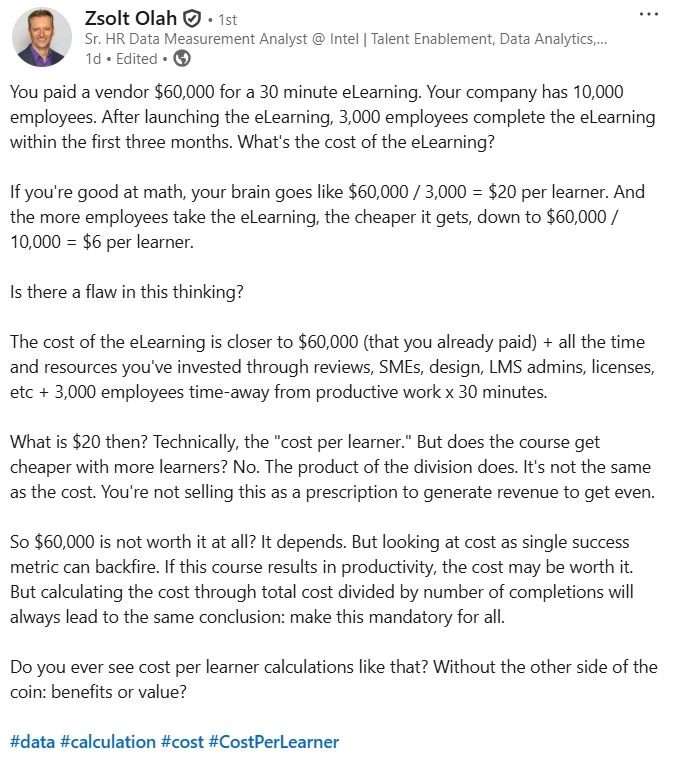
– In learning and development, “cost per learner” is one of those metrics that sounds simple, logical, and satisfying. Take the total development cost of an eLearning program, divide it by the number of employees who complete it, and voilà, you’ve got a clean figure you can put on a slide.
But here’s the truth: cost per learner is a math trick, not a measure of value.
The Flaw in the $20 Calculation
Imagine this: your company pays a vendor $60,000 for a 30-minute eLearning course. You have 10,000 employees, and within the first three months, 3,000 of them complete it. Divide $60,000 by 3,000 and you get $20 per learner. If all 10,000 eventually take it, that drops to $6 per learner.
But here’s the flaw: the actual cost of the program is not shrinking as more employees complete it. The investment was already made up front. The “$20” is just the product of division; it’s not a reflection of the true economic picture.
The Hidden Costs
That $60,000 invoice is only part of the investment. The real cost includes:
- Subject Matter Experts (SMEs): Time spent reviewing, revising, and validating content.
- L&D Team: Instructional designers, reviewers, LMS administrators, and project managers.
- Licenses and Platforms: The learning management system (LMS) or delivery platform fees.
- Employee Time: 3,000 employees × 30 minutes each = 1,500 hours away from other work.
When you add these hidden costs, the true investment is far higher than $60,000.
Cost Alone Doesn’t Equal Value
So, does that mean the eLearning wasn’t worth it? Not necessarily. The real question isn’t “What did it cost per learner?” but rather:
- Did this program improve productivity?
- Did it reduce compliance risk?
- Did it increase safety, customer satisfaction, or sales?
If the answer to any of these is yes, then the $60,000 might be one of the best investments you’ve made. If not, then even $6 per learner is expensive.
My Response to Zsolt-
**“Cost-per-learner is a math trick, not a value measure. You didn’t buy $20 per person—you bought a $60K learning asset plus all the hidden time/effort behind it.
The real question: did it change behavior or improve outcomes?
If yes → $60K is cheap.
If no → even $6 per learner is expensive.
Completion counts don’t equal ROI. Impact does.”**
Why “Make It Mandatory” Is the Wrong Conclusion
When cost per learner is used as the success metric, it often leads to the same knee-jerk response: make it mandatory. That ensures the denominator (completions) goes up and the cost per learner goes down.
But mandatory completions don’t guarantee impact. In fact, they can erode trust in L&D when employees feel forced through content that doesn’t feel relevant or valuable.
A Better Lens: Cost to Impact
Instead of asking, “What’s the cost per learner?” the more strategic question is:
“What’s the cost compared to the impact?”
This shifts the conversation from vanity math to business value. A $60,000 eLearning that prevents a single regulatory fine or workplace accident could pay for itself many times over. On the other hand, an eLearning that merely checks the box without making any meaningful changes is overpriced at any cost.
Final Takeaway
Cost per learner can be a useful descriptive metric, but it should never be the only one. What matters most is not how many employees completed a course, but what difference that course made for the business.
The next time someone throws out a neat “$20 per learner” figure, push back with the other side of the coin: benefits and value. That’s where the true ROI of eLearning lives.