Everyone wants to say, "keep a human in the loop." It sounds responsible. It sounds safe. It sounds like oversight. But in AI-enabled systems, human proximity is not the same thing as human responsibility.
A person standing nearby does not automatically make an automated system accountable. A supervisor copied on the report does not mean meaningful judgment occurred. A teacher, manager, analyst, or administrator reviewing an output after the fact does not mean the system was governed well before the decision was made. That distinction matters.
As AI moves from generating content to shaping workflows, prioritizing tasks, flagging risks, recommending actions, routing decisions, and even triggering next steps, organizations need a stronger definition of responsibility. The question is no longer simply, "Was a human involved?" The better question is: Was responsibility designed into the system before action happened?
The Problem With "Human in the Loop" Thinking
The phrase "human in the loop" has become one of the most common responses to concerns about AI. When people raise questions about bias, error, automation, safety, or accountability, the answer is often some version of: "We will keep a human in the loop." That may be necessary, but it is not sufficient.
The problem is that many systems move faster than human judgment can meaningfully evaluate. If an AI-supported workflow produces a recommendation, assigns a risk score, generates a response, routes a student, flags an employee, prioritizes a customer, or escalates a case, the moment of responsibility cannot begin only after the system has acted. By then, the organization may already be managing consequences instead of governing decisions.
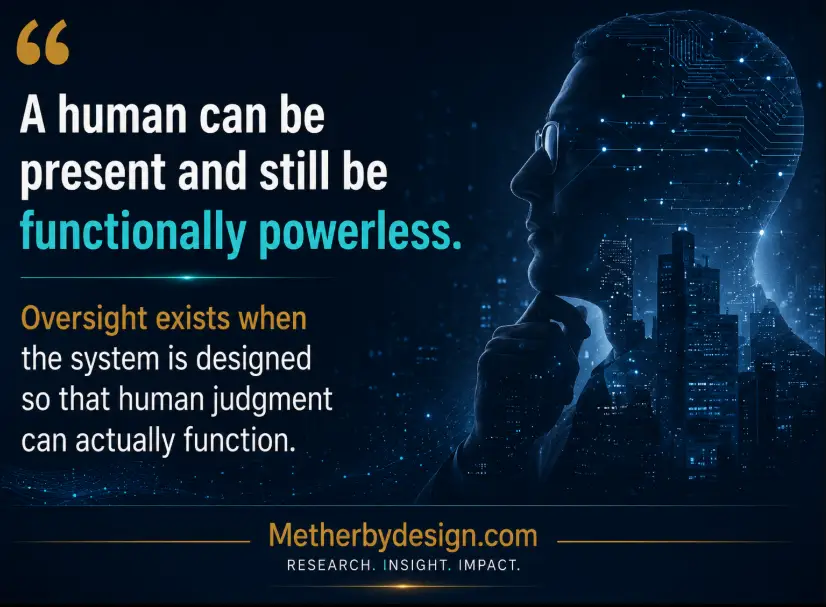
In practice, "human in the loop" often becomes a vague assurance rather than an operational safeguard. A human can be present and still be functionally powerless. A human can approve something they do not understand. A human can inherit a decision pathway that was never designed for meaningful judgment.
That is not governance. That is proximity.
Responsibility Has to Be Designed Earlier
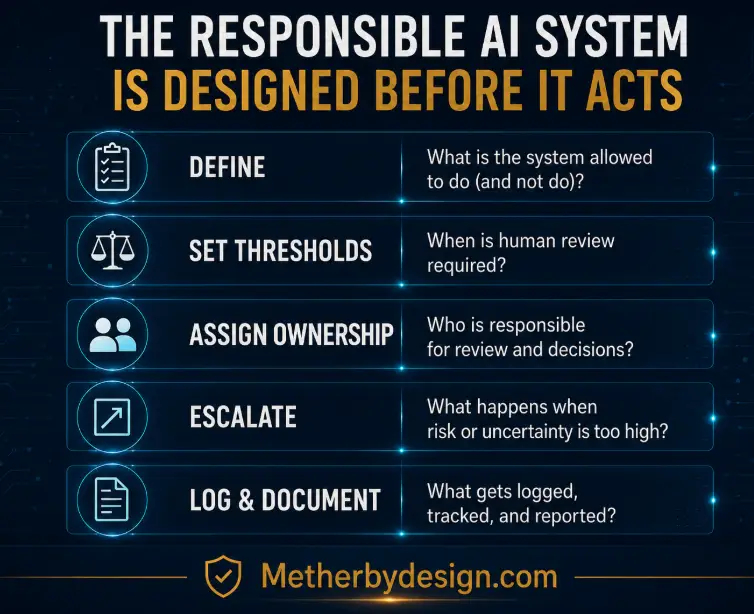
Responsible AI cannot depend on last-minute approval. It has to be embedded before the system acts. That means organizations need to define the rules, thresholds, escalation points, review expectations, and ownership structures in advance.
Before AI is allowed to recommend, route, score, summarize, classify, intervene, or act, the organization should be able to answer: What is the system allowed to do? What is it not allowed to do? When does human review become mandatory? Who is responsible for reviewing the output? What evidence does the human need to evaluate the recommendation? What happens when the system is uncertain or when the stakes are high? What gets logged, escalated, or stopped?
These questions are not abstract. They are the operating conditions of responsible AI. If they are not answered before deployment, they will be answered informally during pressure, failure, confusion, or harm.
Oversight Is Not a Person. It Is a Design Choice.
One of the biggest mistakes organizations make is treating oversight as a role rather than a system condition. Oversight does not exist simply because someone has a title. Oversight exists when the system is designed so that human judgment can actually function.
That means the person responsible for review must have enough information to evaluate the output — understanding what the system did, what it used, what it ignored, and what assumptions may be embedded in the recommendation. They must know when to trust, when to question, when to revise, and when to reject.
This is where many AI implementations fail. They train people on tools but not judgment. They provide access but not criteria. They allow experimentation but not escalation. They encourage adoption but do not define responsibility. The result is a dangerous gap — AI is placed into a workflow, but the organization has not clarified who owns the decision, what counts as acceptable use, or how human review should actually happen. That is not readiness. That is exposure.
The LAIR Connection: Responsibility Is the Final Loop
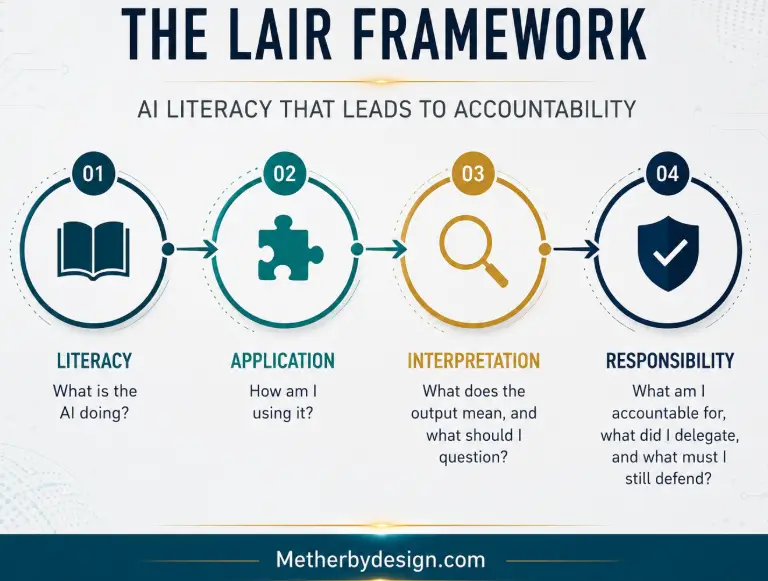
This is one reason the LAIR Framework places responsibility as a distinct and necessary part of AI literacy. Literacy asks: What is the AI doing? Application asks: How am I using it? Interpretation asks: What does the output mean, and what should I question? Responsibility asks: What am I accountable for, what did I delegate, and what must I still defend?
The responsibility loop is where AI use becomes organizational practice. It is the difference between using AI as a tool and governing AI as part of a decision environment. Without responsibility, AI literacy stays shallow. People may know how to prompt, generate outputs, and use tools efficiently — but they may not know how to account for the consequences of what the tool produces.
The future of AI readiness will not be determined by who has the most tools. It will be determined by who can create the clearest connection between AI activity, human judgment, and accountable action.
The Real Question for Organizations
Organizations should stop asking only whether AI is being used. They should start asking whether AI use is being governed at the point where decisions are shaped — in classrooms, hiring processes, customer service workflows, compliance reviews, procurement decisions, professional development systems, student support processes, knowledge management systems, and leadership dashboards.
In each case, the issue is not just whether AI produced an output. The issue is whether the organization designed a responsible pathway around that output — including clear use cases, defined limits, risk thresholds, review requirements, escalation procedures, documentation expectations, and ownership.
Explore AI-ReadinessSpeed is not the same as maturity. Automation is not the same as intelligence. Efficiency is not the same as responsibility.
From AI Adoption to AI Readiness
Many organizations are currently focused on AI adoption. They want people to use the tools. They want productivity gains. They want faster workflows. They want to keep up. But adoption without readiness creates risk.
Readiness asks a deeper set of questions. Are people prepared to evaluate what AI produces? Are leaders prepared to govern where AI enters the workflow? Are policies connected to actual practice? Are employees clear on what they can and cannot delegate? Are escalation points defined before the stakes become urgent?
Governance is not just a policy document. It is not just a committee. It is not just a statement that says humans remain responsible. Governance is the design of the system before action — deciding where AI belongs, where it does not belong, where human review is required, and what evidence is needed before a recommendation becomes a decision.
Responsibility Before Action
The next phase of AI implementation will require organizations to move beyond surface-level assurances. It will not be enough to say, "We have a human in the loop." Organizations will need to prove that the loop has been designed well enough for human judgment to matter.
That means responsibility must be built into the system before action happens — before the recommendation, before the escalation, before the automated response, before the risk score, before the decision pathway becomes normal.
The organizations that understand this will be better positioned to use AI with confidence. They will not just adopt tools. They will build systems where literacy, application, interpretation, and responsibility work together.
That is the real work of AI readiness. Not just using AI. Not just approving AI. Not just keeping a person nearby.
Designing responsibility into the system before action.
Explore AI-Readiness