Quadruple Loop Learning: The Next Step in Educational Transformation
Most schools are familiar with reflection. Teachers review lessons, students revise work, and leaders examine outcomes. But in a world shaped by artificial intelligence, rapid change, and complex social challenges, reflection alone is no longer enough.
That is where Quadruple Loop Learning becomes powerful.
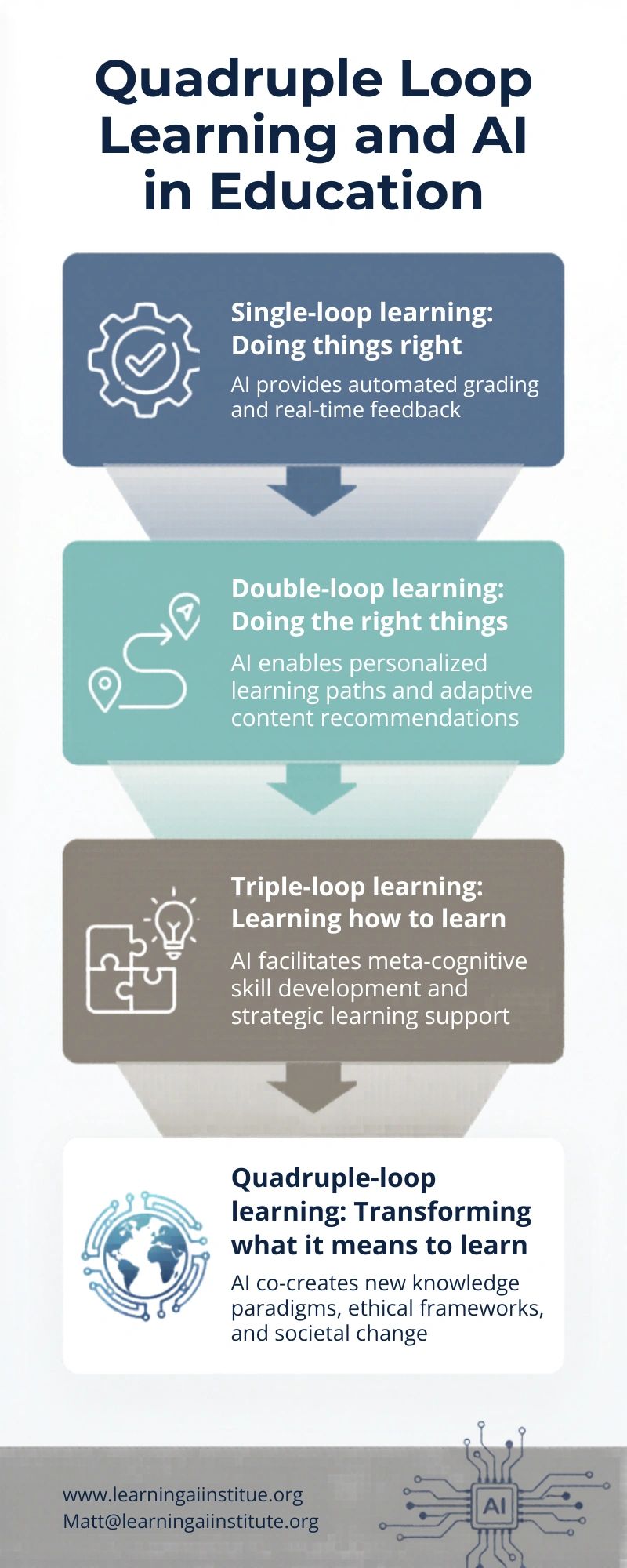
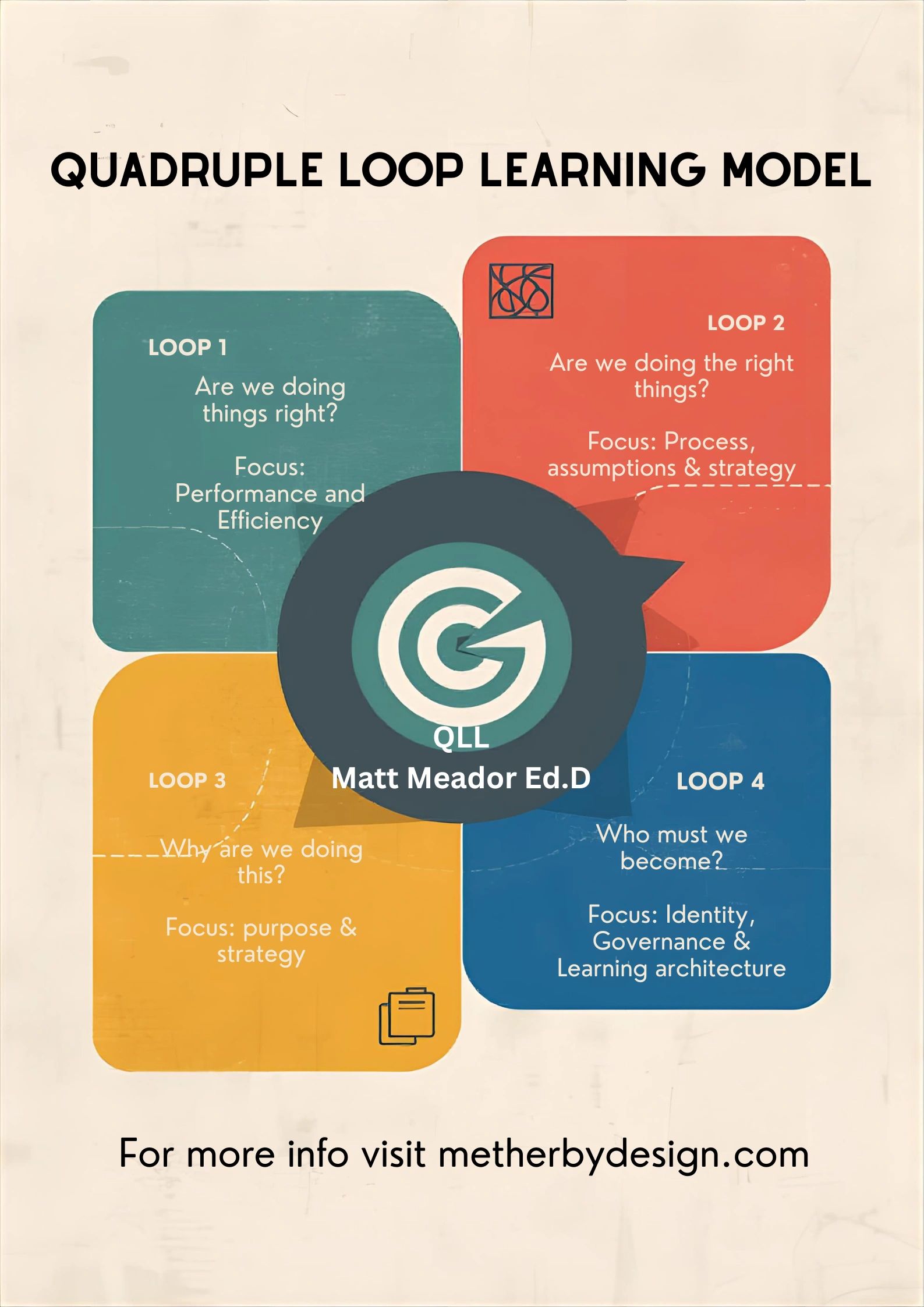
Single-loop learning asks, “Are we doing things right?”
Double-loop learning asks, “Are we doing the right things?”
Triple-loop learning asks, “How do we know what is right?”
Quadruple-loop learning goes even deeper: “Who are we becoming as we learn?”
In education, this matters because learning is not only about improving test scores or adopting new tools. It is about shaping identity, agency, ethics, and purpose. Quadruple Loop Learning invites schools to examine not just practices and assumptions, but the larger human consequences of those practices.
For example, when a school introduces AI tools, single-loop learning might focus on whether students are using the tool correctly. Double-loop learning might question whether the assignment design still makes sense. Triple-loop learning might examine how the school defines originality, authorship, and assessment. Quadruple-loop learning asks something more profound: What kind of learners, teachers, and communities are we creating through our use of AI?
This level of learning requires courage. It asks educators to move beyond compliance and toward transformation. It asks leaders to consider whether innovation is serving human development or simply accelerating old systems.
Quadruple Loop Learning is especially important now because AI is not just another classroom tool. It changes how students access information, express ideas, receive feedback, and understand their own intelligence. Without deeper reflection, schools risk using powerful technologies to reinforce shallow learning.
The opportunity is much bigger.
With Quadruple Loop Learning, schools can use AI as a catalyst for rethinking education itself. They can design learning experiences that promote literacy, application, interpretation, responsibility, creativity, and ethical judgment. They can prepare students not only to use AI, but to question it, guide it, and lead with wisdom in an AI-shaped world.
The future of education will not be defined by tools alone. It will be defined by the depth of our learning loops.
And the deepest question is not simply, “What can AI do?”
It is: Who are we becoming with it?
For more information on the Quad-Loop Model and AI in Education, check out LearningAIInstitute.org
Matt@LearningAIInstititute.org