Much of the public conversation around artificial intelligence in education focuses on prompting.
How should students write prompts?
What prompt structures work best?
How can educators teach prompt engineering?
These are important questions, but they are incomplete.
If education only teaches students how to get better outputs from AI, then schools risk training students to become efficient users instead of thoughtful learners. The goal of education has never been simply producing answers faster. The goal is developing the ability to think, interpret, question, and apply judgment.
That distinction matters more now than ever.
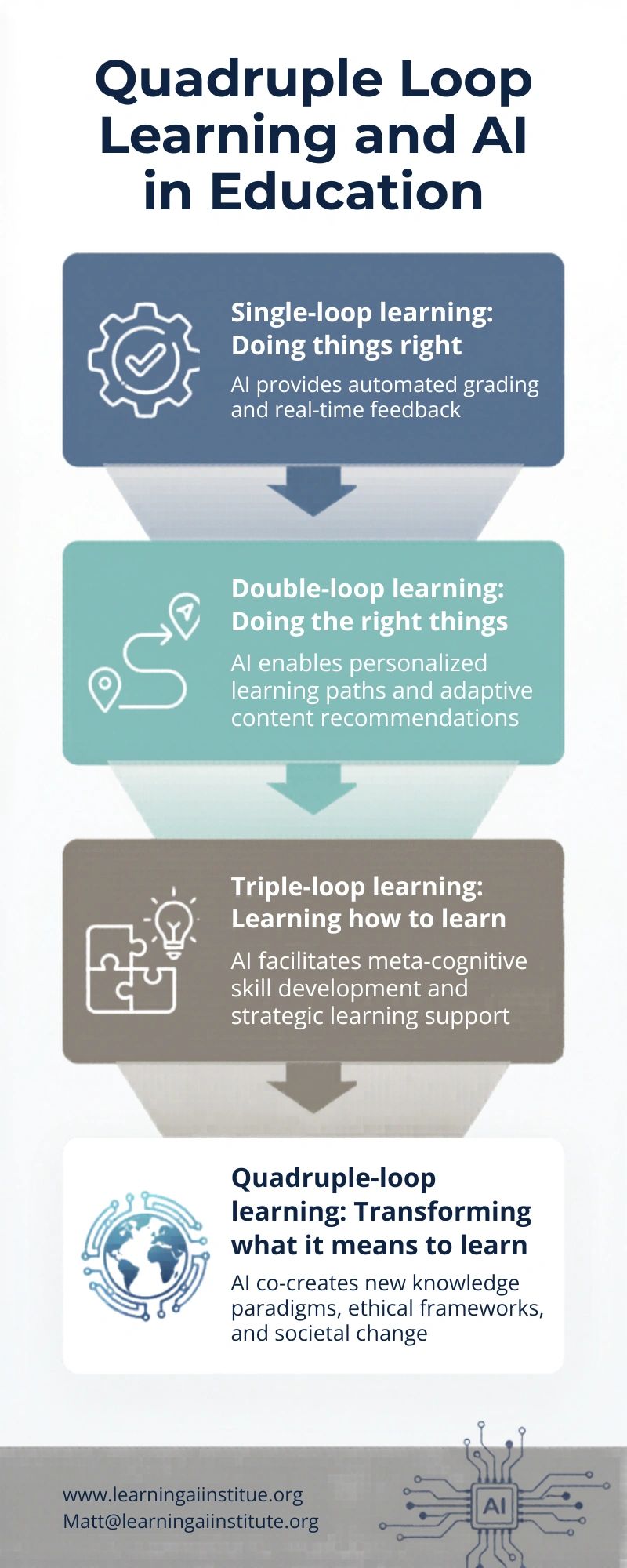
The future of AI literacy is not about prompting alone. It is about understanding how AI changes human thinking. This is where Quadruple Loop Learning becomes essential.
AI should not merely accelerate productivity. It should deepen cognition.
The Shift From Tool Use to Cognitive Partnership
For decades, digital tools mostly functioned as passive systems. Word processors stored writing. Search engines retrieved information. Spreadsheets organized calculations.
AI is different.
Modern generative AI systems actively participate in the learning process. They suggest, summarize, revise, explain, compare, infer, and generate. Students are no longer interacting with static tools. They are interacting with systems that shape inquiry itself.
Researchers at Stanford’s Human-Centered Artificial Intelligence Institute note that generative AI systems increasingly act as collaborative cognitive tools rather than simple automation systems. (hai.stanford.edu)
That changes education fundamentally.
The challenge is no longer whether students can access information. The challenge is whether students remain cognitively engaged while AI participates in the process.
This creates a dangerous possibility:
Students may outsource thinking without realizing they have done so.
Prompting Is Not the Same as Thinking
A well-written AI prompt can produce impressive results. Students can generate essays, research summaries, discussion questions, coding support, and study materials within seconds.
But producing an answer is not the same as understanding it.
Cognitive science research consistently shows that durable learning depends on active mental engagement, retrieval, reflection, and meaning-making rather than passive consumption. (American Psychological Association)
In practice, this means students must do more than ask AI for information.
They must:
Evaluate the response
Compare perspectives
Identify inaccuracies
Question assumptions
Interpret meaning
Apply judgment
Connect ideas to prior knowledge
Without these steps, prompting becomes intellectual outsourcing rather than intellectual development.
That is why AI literacy cannot stop at technical proficiency.
Metacognition in the Age of AI
Metacognition is commonly defined as “thinking about thinking.” Educational psychologist John Flavell introduced the concept to describe how learners monitor and regulate their own cognitive processes. (simplypsychology.org)
AI intensifies the importance of metacognition because learners now interact with systems capable of influencing reasoning itself.
Students must ask:
Why did I trust this output?
Why did this answer sound convincing?
What assumptions did I fail to question?
Did I actually understand the explanation?
Did AI support my learning, or bypass it?
These questions represent a major shift in educational responsibility.
Traditionally, students reflected on their own work. Now they must reflect on the interaction between human cognition and machine-generated information.
This is no longer simple reflection. It is recursive thinking about how thinking itself is being shaped.
That is the foundation of Quadruple Loop Learning.
The Four Loops Revisited
Quadruple Loop Learning expands traditional learning models by introducing responsibility and cognitive awareness into AI-assisted learning.
Loop 1: Task Completion
The student completes the assignment.
Example:
Using AI to generate a summary of a historical event.
Loop 2: Strategic Improvement
The student improves the process.
Example:
Refining prompts, requesting multiple perspectives, or restructuring questions.
Loop 3: Cognitive Examination
The student reflects on underlying assumptions and understanding.
Example:
Recognizing bias, identifying gaps in knowledge, or realizing misconceptions.
Loop 4: Responsible Judgment
The student evaluates the ethical and intellectual implications of AI use.
Example:
Determining whether AI enhanced understanding or merely replaced effort.
This fourth loop is where AI literacy becomes deeply human rather than merely technical.
Learner Agency Matters More Than Ever
One of the greatest risks in AI-integrated education is the erosion of learner agency.
Agency refers to the learner’s capacity to act intentionally, make decisions, and remain cognitively responsible for their learning process.
If students become passive consumers of AI-generated outputs, they may lose confidence in their own reasoning abilities over time. Research from UNESCO emphasizes that AI in education must preserve human autonomy, critical thinking, and learner empowerment rather than creating dependency. (unesco.org)
This means students need structured opportunities to:
Challenge AI outputs
Defend their reasoning
Explain decisions
Justify interpretations
Revise conclusions independently
In other words, AI literacy must preserve the student as the thinker.
AI can support cognition, but it cannot replace intellectual responsibility.
How the LAIR Framework Supports This Shift
The Learning AI Institute’s LAIR Framework provides a structure for maintaining learner agency in AI-assisted environments.
LAIR stands for:
Literacy
Understanding AI systems, sources, and capabilities
Application
Using AI intentionally and strategically
Interpretation
Evaluating outputs critically and contextually
Responsibility
Making ethical and accountable decisions with AI
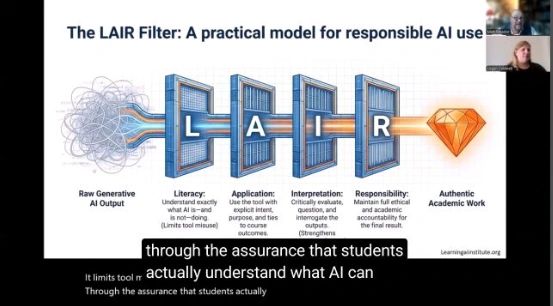
This framework aligns naturally with Quadruple Loop Learning because it emphasizes both technical skill and cognitive accountability.
The framework does not treat AI literacy as simple tool usage. Instead, it focuses on the interaction between human judgment and AI-supported learning.
That distinction is increasingly important as AI systems become more sophisticated and persuasive.
A Classroom Example
Imagine two students using AI to help write a persuasive essay.
Student A
Uses AI to generate the essay.
Makes minor edits.
Submits the final draft.
The work may appear polished, but the student’s thinking process remains largely invisible.
Student B
Uses AI to brainstorm arguments.
Compares multiple outputs.
Identifies weak reasoning.
Checks sources independently.
Rewrites sections in their own words.
Explains why certain AI suggestions were rejected.
Both students used AI.
Only one engaged in meaningful cognitive development.
The difference is not the tool. The difference is the learning process surrounding the tool.
That process is what Quadruple Loop Learning attempts to protect.
Why This Matters for Schools
Educational systems are currently under pressure to respond quickly to AI adoption. Many institutions focus on policy enforcement, plagiarism detection, or prompt training.
– Responses address symptoms, not the deeper issue.
– The central challenge is not whether students use AI.
– The challenge is whether students remain intellectually engaged while using AI.
Schools that focus only on restriction will fall behind. Schools that focus only on efficiency may unintentionally weaken critical thinking. The future belongs to systems that teach students how to think with AI without surrendering judgment to it. That is the purpose of Quadruple Loop Learning.
Prompting is a skill, and thinking is a responsibility. As AI becomes embedded in education, students must learn more than how to interact with machines. They must learn how to remain reflective, critical, responsible, and cognitively present during those interactions. Quadruple Loop Learning shifts the focus from output generation to intellectual development. The goal is not to produce students who can simply use AI effectively. The goal is to produce learners who can think deeply in a world shaped by AI.
For more on the sources in this…
Flavell, J. H. “Metacognition and Cognitive Monitoring.” American Psychologist, 1979. (apa.org)
UNESCO. Recommendation on the Ethics of Artificial Intelligence. (unesco.org)
Stanford HAI. Generative AI and the Future of Work. (hai.stanford.edu)
American Psychological Association. Top 20 Principles from Psychology for PreK-12 Teaching and Learning. (apa.org)
Learning AI Institute. AI Literacy for Students Overview.
Learning AI Institute. LAIR™ Learning System Architecture Documentation. metacognition and AI metacognition and AI